

Digital Attendance System for Schools: 10 Proven Benefits
Managing teachers and support staff efficiently is essential for the smooth operation of any educational institution. Schools employ teachers, administrators, accountants, receptionists, drivers, security personnel, cleaners, and other team members who may work different hours and shifts.
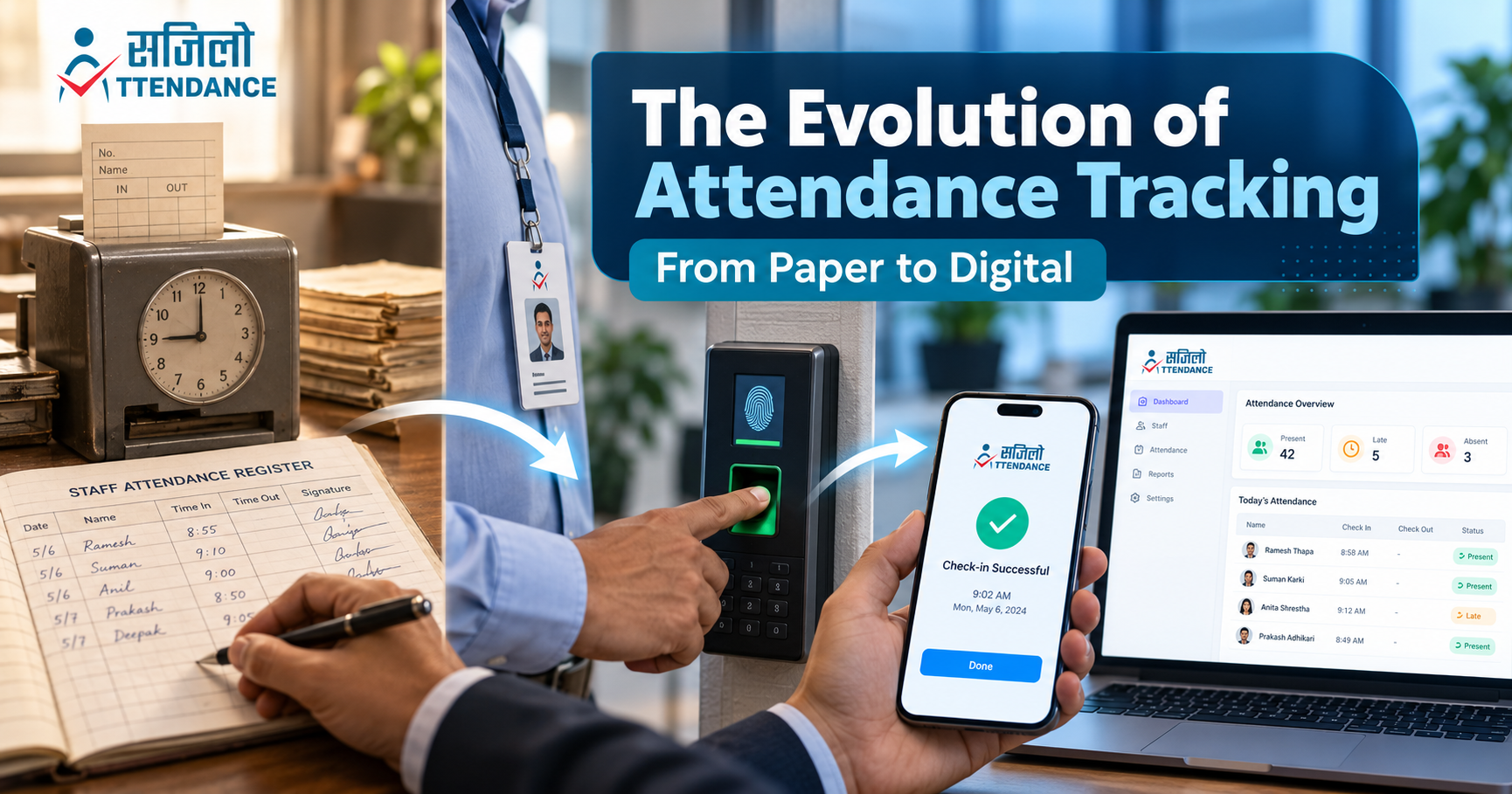
When staff attendance is managed using paper registers or spreadsheets, checking arrival times, calculating working hours, and preparing monthly reports can become complicated. Manual records may contain mistakes, get misplaced, or require several hours of administrative work every month.
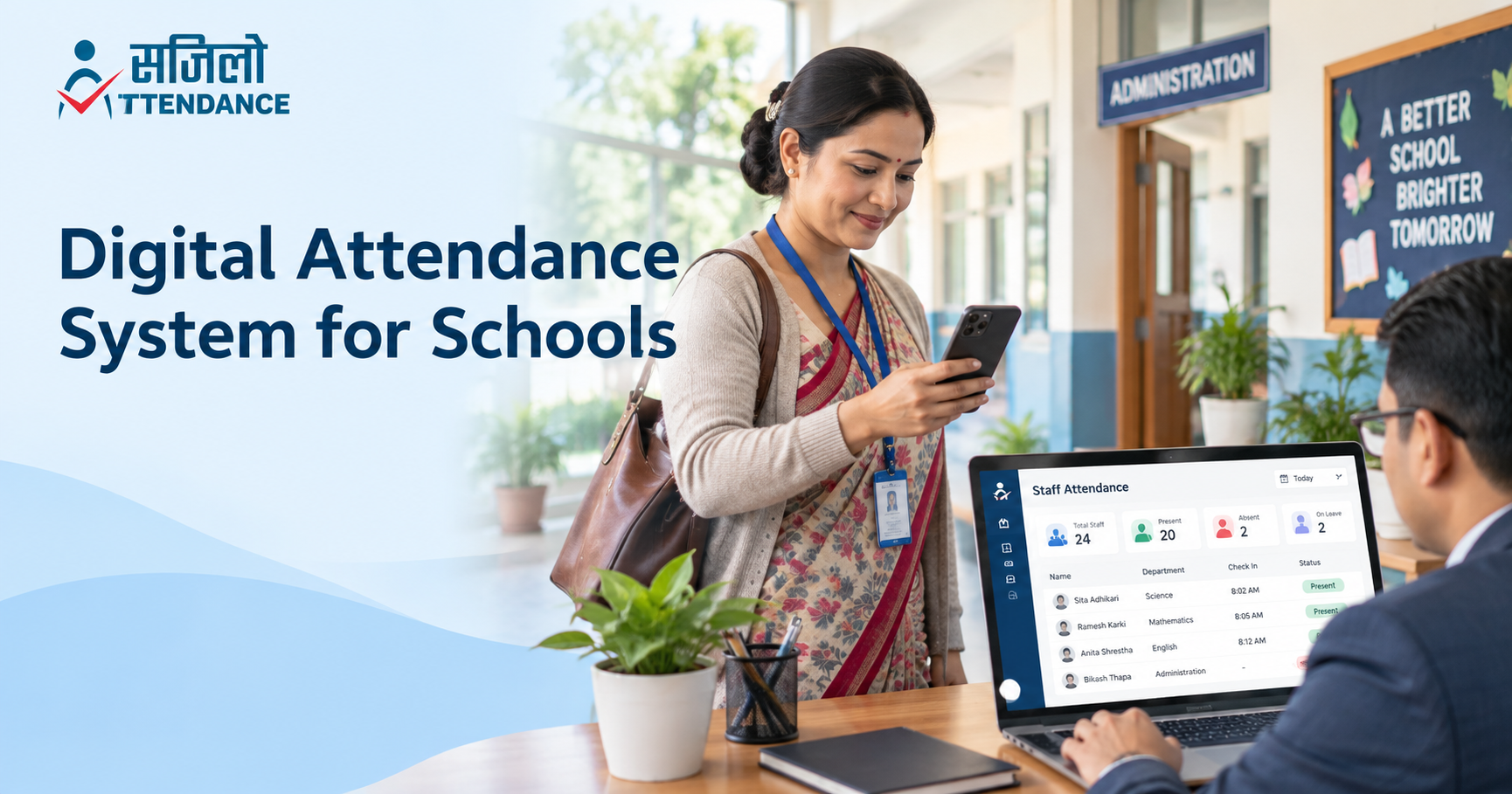
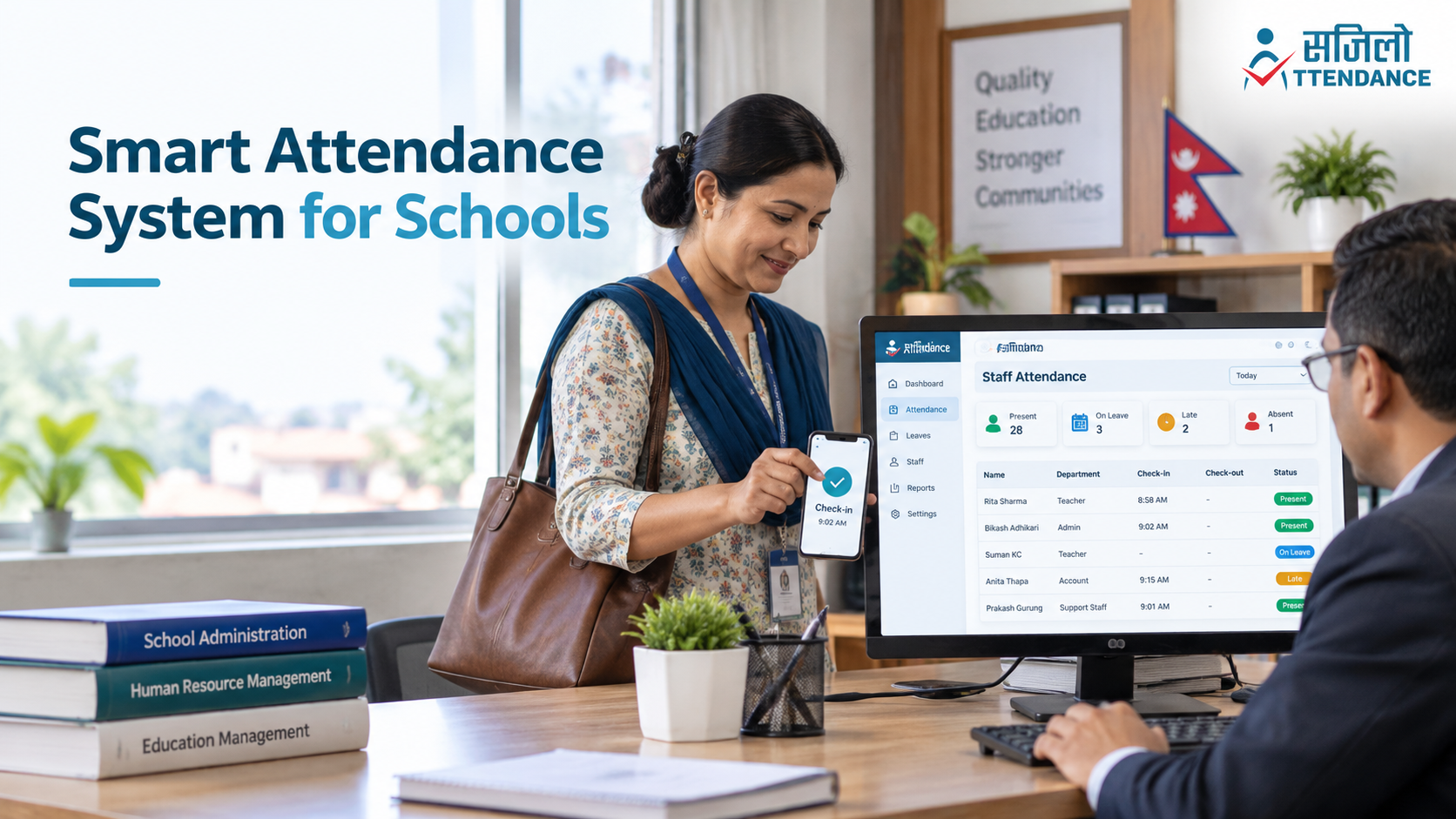
A digital attendance system for schools gives management a faster and more organized way to record staff attendance, process leave requests, manage shifts, and prepare reports. It creates a central source of attendance information that authorized administrators can access when required.
Solutions such as Sajilo Attendance combine mobile attendance, biometric authentication, location-based check-ins, and real-time reports to help schools manage their workforce more efficiently.
What Is a Digital Attendance System for Schools?
A digital attendance system for schools is a software platform used to record and manage the attendance of teachers and other school employees. Instead of signing a paper register, staff members record their arrival and departure through an approved digital method.
Depending on the platform, staff attendance can be registered using:
- A mobile application
- Fingerprint authentication
- Facial authentication
- Location-based check-in
- A web-based dashboard
- A biometric attendance device
- QR codes or employee identification cards
The system stores attendance records electronically. School administrators can then review staff arrival times, departure times, working hours, leave requests, and shift schedules from one dashboard.
Modern education management increasingly relies on organized digital information. UNESCO’s work on Education Management Information Systems explains how digital transformation has expanded education data systems beyond traditional school census records to include information from human resources and other management systems. www.unesco.org
Why Manual Staff Attendance Creates Problems
Paper registers may work for a very small team, but they become difficult to manage as a school grows. A manual system can create several operational problems:
- Staff may forget to record their arrival or departure.
- Handwritten times may be unclear.
- Records can be changed without a reliable audit trail.
- Administrators must calculate working hours manually.
- Leave information may be stored separately.
- Monthly reports take longer to prepare.
- Managing multiple branches becomes complicated.
- Attendance information may not be available in real time.
- Payroll calculations may be based on incomplete records.
- Old registers can be difficult to locate.
A digital staff attendance system organizes these activities in one place and reduces dependence on paperwork.
10 Benefits of a Digital Attendance System for Schools
1. Accurate Staff Attendance Records
Manual attendance registers depend heavily on employees entering the correct time. Records can contain missing entries, unreadable handwriting, or inaccurate check-in information.
A digital attendance system records attendance in a structured format. Depending on the selected method, it may capture:
- Staff member’s name
- Check-in time
- Check-out time
- Date of attendance
- Approved work location
- Assigned shift
- Late arrival
- Early departure
- Total working hours
Time-stamped information gives administrators a more consistent attendance history. It also makes it easier to review corrections and resolve disagreements about attendance.
2. Faster Check-In and Check-Out
Teachers and support staff should not have to wait in a queue to sign a register when they arrive at school. A mobile or biometric attendance system allows employees to check in within seconds.
Sajilo Attendance supports secure biometric login through compatible mobile devices. Staff members can use fingerprint or facial authentication supported by their devices to access the application and record attendance.
Fast check-in is especially valuable for schools where many employees arrive at nearly the same time before morning assembly or the first class.
3. Real-Time Attendance Monitoring
With a paper register, school management cannot review complete attendance information until the register reaches the administration office. A digital system can make submitted records available immediately.
Authorised administrators may be able to see:
- Which staff members are present
- Who has not checked in
- Who arrived late
- Which employees are on approved leave
- Who left before the scheduled time
- Which branch an employee checked into
- Whether attendance was recorded from an approved location
Real-time monitoring allows management to respond quickly. If a teacher is unexpectedly absent, the school can arrange a substitute before the class begins instead of discovering the absence later.
4. Better Leave Management
Managing leave through verbal requests, paper forms, or personal messages can cause confusion. A request may be overlooked, and employees may not know whether their leave has been approved.
A digital attendance system can provide a clear workflow for staff leave. Employees can submit requests through the application, and an authorized administrator can review, approve, or reject them.
A central leave-management process helps schools track:
- Casual leave
- Sick leave
- Annual leave
- Maternity or paternity leave
- Unpaid leave
- Emergency leave
- Remaining leave balances
- Approval history
Schools should configure leave categories according to their employment policies and applicable legislation. Institutions operating in Nepal should review the official Labour Act, 2074, and seek professional guidance when necessary.
5. Easier Shift and Schedule Management
Not every school employee follows the same timetable. Teachers may have scheduled periods, while guards, drivers, receptionists, cleaners, and hostel employees may work different shifts.
A digital attendance platform can help administrators assign and monitor separate working schedules. This is useful for managing:
- Morning and day shifts
- Transportation staff schedules
- Security rotations
- Hostel staff
- Administrative office hours
- Examination duties
- Weekend programs
- Special school events
Clear shift records help management understand whether employees are attending according to their assigned schedules. The International Labour Organization provides guidance on developing balanced working-time arrangements, which schools may consult while designing staff schedules. International Labour Organization
6. Simplified Payroll Preparation
Payroll becomes difficult when attendance, leave, overtime, and late-arrival records are maintained in different files. HR or accounts staff may spend hours comparing registers before calculating salaries.
A properly configured digital attendance system can provide organized data for payroll preparation. Depending on the selected plan and integration, administrators may use it to review:
- Total working days
- Days present
- Approved leave
- Unpaid leave
- Late arrivals
- Early departures
- Overtime
- Shift-based attendance
- Absence deductions
Sajilo Attendance includes payroll management in selected plans. Schools can explore its attendance and HR services to determine whether the available features meet their payroll requirements.
Attendance information should be reviewed by an authorized person before salary calculations are finalized. Software can organize information, but schools should not apply automatic deductions without appropriate verification and a fair correction process.
7. Reduced Proxy Attendance
Proxy attendance occurs when one employee records attendance for another person. This is more difficult to prevent with an open paper register or shared login.
Biometric authentication and individual mobile accounts can reduce this risk. Each employee uses an assigned account or approved authentication method, creating a more reliable connection between the employee and the attendance record.
The NIST Digital Identity Guidelines provide recognized principles for identity proofing, authentication, and account security. Although these guidelines were developed for government information systems, their security concepts can help organizations evaluate digital authentication practices. CSRC
Biometric technology must still be implemented responsibly. Schools should provide a correction process for failed or incorrect check-ins and consider an appropriate alternative for employees who cannot use a particular biometric method.
8. Multi-Branch Attendance Management
Educational groups may operate a main school, secondary campus, kindergarten, college, hostel, or administrative office in different locations. Maintaining separate registers makes it difficult to compare attendance across branches.
A multi-branch attendance system enables authorized management to review records from one central dashboard. Branch managers can oversee their own employees, while senior administrators can access consolidated reports.
This can help institutions monitor:
- Attendance at each location
- Branch-specific lateness
- Staff transfers between branches
- Different working schedules
- Leave across all locations
- Combined workforce reports
Sajilo Attendance offers multi-branch functionality across its available plans. Schools can compare the Sajilo. Attendance pricing plans according to their number of branches, employees, and required administrative access.
9. Automated Staff Attendance Reports
Preparing weekly or monthly attendance reports manually takes time. An administrator may need to count entries, calculate absences and transfer totals into another spreadsheet.
A digital system can automatically organise stored attendance information into reports. Depending on the platform, schools may generate:
- Daily staff attendance reports
- Monthly attendance summaries
- Late-arrival reports
- Leave reports
- Shift reports
- Individual employee histories
- Branch-wise attendance reports
- Working-hour summaries
- Payroll-supporting records
Automated reporting gives administrators more time to focus on meaningful HR and school-management responsibilities.
Reports can also help management identify patterns. For example, repeated late arrivals in one department may indicate a scheduling or transportation problem rather than an issue with one employee.
10. More Informed Management Decisions
Reliable staff attendance information helps school leaders make practical decisions. Instead of relying on assumptions, administrators can review historical patterns and understand how attendance affects school operations.
Management may use attendance reports to examine:
- Departments experiencing frequent staff shortages
- Days with higher absence rates
- The need for substitute teachers
- Shift coverage for support staff
- Staffing requirements at different branches
- Workload distribution
- Leave trends
- Punctuality improvements
Attendance data should be used constructively. The purpose is to improve planning, fairness and accountability—not to create unnecessary surveillance or pressure.
Important Features Schools Should Look For
Before selecting a digital attendance system, schools should compare features according to their workforce structure.
Biometric Authentication
Biometric authentication can provide secure access and reduce shared-account use. However, biometric information is sensitive and requires careful handling.
Guidance from the UK Information Commissioner’s Office explains that employers using biometric information for time and access control should consider necessity, proportionality, security and potential effects on workers. Schools should review the biometric monitoring guidance and follow the privacy laws applicable in their own country. ICO
Location-Based Attendance
Location-based attendance can allow staff members to check in only from an approved school or branch location. This is useful for institutions that prefer mobile attendance without installing separate hardware.
The school should clearly inform employees about:
- When location is collected
- Whether location is tracked continuously
- Why the information is required
- Who can view it
- How long it is retained
Location should generally be collected only when necessary for attendance rather than used for continuous employee tracking.
Real-Time Dashboard
The dashboard should clearly display present, absent, late and on-leave employees. It should also provide filters for dates, branches, departments and individual staff members.
Leave and Shift Management
Schools should choose a system that allows employees to request leave and administrators to approve it through a documented process. Shift tools should support the different schedules followed by teaching and non-teaching staff.
Role-Based Access
Not every user should have access to every record. Permissions should be assigned according to responsibility.
For example:
- Employees access their own records.
- Department heads review their teams.
- HR staff manage leave and attendance.
- Accounts staff access payroll-related information.
- Senior administrators review branch-level reports.
The OWASP access-control guidance recommends principles such as minimum necessary access and permission checks for every request.
Audit Logs
An audit log records important actions performed inside the platform. It may show who edited an attendance entry, approved leave or changed a shift.
The OWASP logging guidance explains how application logs can support security monitoring, operational review and accountability.
Secure Account Protection
Administrators should use unique accounts and strong passwords. High-level accounts should use additional security wherever available.
The Cybersecurity and Infrastructure Security Agency recommends strong passwords and password managers as part of safer account protection.
Data Backup and Export
The school should be able to export essential attendance records in a usable format. The provider should also explain:
- How frequently information is backed up
- Where backups are stored
- How deleted information is handled
- What happens if the school ends the service
- Whether reports can be downloaded
Data Security Standards
Schools should ask how the provider protects information during storage and transmission. The ISO/IEC 27001 information-security standard provides an internationally recognised framework for managing information-security risks.
Certification is not the only consideration, but clear security policies, access controls, backups and incident-response procedures are important when choosing a provider.
Staff Privacy and Ethical Attendance Management
A digital attendance system should support school management without violating employee privacy. Schools must be transparent about what information is collected and how it will be used.
Before implementation, management should prepare a written attendance policy explaining:
- The purpose of the system
- The information being collected
- The attendance method being used
- Who can access the records
- How long information will be retained
- How employees can report an error
- How leave and late arrivals are handled
- Whether information is connected to payroll
- What happens when the system is unavailable
The European Commission’s overview of data protection in the European Union provides useful general principles concerning transparency, purpose limitation and responsible handling of personal information. Schools must ultimately follow the laws that apply in their own location.
Digital Attendance System Versus Manual Staff Registers
| Management Area | Manual Register | Digital Attendance System |
|---|---|---|
| Staff check-in | Written by hand | Mobile or biometric check-in |
| Recording speed | Slower during busy periods | Usually completed within seconds |
| Accuracy | Vulnerable to handwriting and entry errors | Structured and time-stamped |
| Real-time visibility | Not normally available | Available to authorised administrators |
| Leave management | Paper forms or messages | Central digital request process |
| Shift management | Separate schedules | Connected with attendance records |
| Monthly reporting | Prepared manually | Generated from stored data |
| Multi-branch management | Separate registers | Central dashboard |
| Payroll preparation | Requires manual comparison | Organised attendance data |
| Record storage | Physical files | Digital records and backups |
| Corrections | May lack a clear history | Can include approval and audit records |
| Administrative workload | High | Reduced through automation |
How Schools Can Implement Digital Staff Attendance
Assess the Existing Attendance Process
Begin by examining how staff currently record attendance. Identify missing entries, reporting delays, payroll difficulties and other recurring issues.
Define the School’s Requirements
Determine the number of employees, departments, shifts, branches and administrators that the system must support.
Select the Attendance Method
Choose an appropriate method such as mobile check-in, location-based attendance. Consider convenience, privacy, reliability and internet access.
Create a Clear Attendance Policy
Explain check-in rules, late-arrival procedures, leave approval, corrections, payroll use and employee responsibilities.
Run a Pilot Programme
Test the system with one department or branch before introducing it throughout the institution.
Train Employees and Administrators
Show staff how to check in, submit leave and report errors. Administrators should learn how to approve requests, correct records and generate reports.
Review the Results
After the pilot period, collect feedback and resolve any technical or policy-related problems before complete implementation.
Common Mistakes to Avoid
Schools should avoid introducing attendance software without adequate planning. Common mistakes include:
- Selecting a system without testing it
- Collecting more employee information than necessary
- Failing to explain attendance rules
- Giving too many users administrative access
- Applying salary deductions without verification
- Using biometric data without suitable safeguards
- Ignoring incorrect or failed check-ins
- Depending on the system without backup procedures
- Failing to train staff
- Treating attendance data as a complete measure of performance
Attendance records show when an employee checked in or out. They do not independently measure teaching quality, productivity or professional commitment.
Why Choose Sajilo Attendance for School Staff?
Sajilo Attendance provides practical tools for managing teachers and other school employees through one digital platform.
Its features include:
- Biometric login
- Location-based check-in
- Real-time attendance tracking
- Attendance and leave requests
- Shift management
- HR database management
- Daily and monthly reports
- Multi-branch support
- Email and push notifications on selected plans
- Payroll management on selected plans
- API access on the Pro plan
- Dedicated support on the Pro plan
Schools can select a plan according to their workforce size and operational requirements. The platform currently offers options for organisations with up to 15, 50 or 100 employees, with different branch and administration limits.
For a practical demonstration, schools can contact Sajilo Attendance and explain their number of employees, branches, shifts and payroll requirements.
Conclusion
A digital attendance system for schools can simplify the management of teachers, administrators and support staff. It provides more accurate attendance records, faster check-ins, easier leave processing, improved shift planning and organised reports.
The right system can also reduce paperwork and give school leaders a clearer understanding of staff availability across departments and branches. However, successful implementation requires more than installing an application. Schools must establish fair policies, train employees, protect personal information and provide a process for correcting inaccurate records.
Sajilo Attendance offers mobile, biometric and location-based attendance features designed to make workforce management more organised. Schools looking to replace manual staff registers can begin with a demonstration, test the system with a small team and expand it after confirming that it meets their needs.
.png)